


Choosing the Right Steel Plate Cutting Method
2026-05-22
Selecting the optimal steel plate cutting method directly affects cost, speed, edge quality, and downstream processing. The three dominant technologies—oxy-fuel, plasma, and laser—each have distinct performance windows based on material thickness, chemistry, and tolerance requirements. This article provides quantitative data to support informed decision-making.
Oxy-Fuel Cutting remains the preferred choice for carbon steel plates thicker than 25 mm. It operates by preheating the steel to approximately 870–980°C, then introducing pure oxygen to oxidize the iron. Typical cutting speeds range from 300 mm/min for 50 mm plate down to 150 mm/min for 150 mm plate. Tolerances are ±0.8 to 1.5 mm, with a kerf width of 1.5–3.0 mm. The heat-affected zone (HAZ) can extend 2–3 mm deep. While capital investment is low (equipment from 20,000–20,000–50,000), operational costs for fuel gases and oxygen are moderate. Oxy-fuel cannot cut stainless steel or aluminum due to their stable oxides.
Plasma Cutting dominates the mid-range (6–50 mm). High-definition plasma systems achieve cutting speeds of 1,500–3,000 mm/min for 12 mm plate, with tolerances of ±0.5–1.0 mm and kerf widths of 1.0–2.0 mm. HAZ depth is typically 0.5–1.5 mm. For a 20 mm carbon steel plate, plasma is 3–4 times faster than oxy-fuel. Capital costs range from 50,000–50,000–150,000 for industrial systems. Consumable life (electrodes and nozzles) is approximately 1–3 hours of arc-on time, costing 2–2–5 per hour of operation.
Laser Cutting offers the highest precision for plates up to 20 mm (fiber lasers) or 25 mm (CO₂ lasers). Cutting speeds on 10 mm mild steel reach 2,000–3,500 mm/min, with tolerances as tight as ±0.1–0.3 mm and kerf widths of just 0.2–0.5 mm. HAZ is minimal at 0.1–0.4 mm. However, capital investment is substantial (300,000–300,000–800,000). Operating costs are driven by electrical consumption and assist gases (nitrogen or oxygen). For thicknesses above 20 mm, laser speed drops dramatically and edge squareness becomes difficult to maintain.
Decision Matrix Based on Thickness
In conclusion, no single method suits all applications. For thin, high-tolerance parts, laser is justified despite its capital cost. For general fabrication in the 6–50 mm range, high-definition plasma offers the best balance of speed, precision, and economy. For thick carbon steel plates above 50 mm, oxy-fuel remains the most practical and cost-effective solution.
Oxy-Fuel Cutting remains the preferred choice for carbon steel plates thicker than 25 mm. It operates by preheating the steel to approximately 870–980°C, then introducing pure oxygen to oxidize the iron. Typical cutting speeds range from 300 mm/min for 50 mm plate down to 150 mm/min for 150 mm plate. Tolerances are ±0.8 to 1.5 mm, with a kerf width of 1.5–3.0 mm. The heat-affected zone (HAZ) can extend 2–3 mm deep. While capital investment is low (equipment from 20,000–20,000–50,000), operational costs for fuel gases and oxygen are moderate. Oxy-fuel cannot cut stainless steel or aluminum due to their stable oxides.
Plasma Cutting dominates the mid-range (6–50 mm). High-definition plasma systems achieve cutting speeds of 1,500–3,000 mm/min for 12 mm plate, with tolerances of ±0.5–1.0 mm and kerf widths of 1.0–2.0 mm. HAZ depth is typically 0.5–1.5 mm. For a 20 mm carbon steel plate, plasma is 3–4 times faster than oxy-fuel. Capital costs range from 50,000–50,000–150,000 for industrial systems. Consumable life (electrodes and nozzles) is approximately 1–3 hours of arc-on time, costing 2–2–5 per hour of operation.
Laser Cutting offers the highest precision for plates up to 20 mm (fiber lasers) or 25 mm (CO₂ lasers). Cutting speeds on 10 mm mild steel reach 2,000–3,500 mm/min, with tolerances as tight as ±0.1–0.3 mm and kerf widths of just 0.2–0.5 mm. HAZ is minimal at 0.1–0.4 mm. However, capital investment is substantial (300,000–300,000–800,000). Operating costs are driven by electrical consumption and assist gases (nitrogen or oxygen). For thicknesses above 20 mm, laser speed drops dramatically and edge squareness becomes difficult to maintain.
Decision Matrix Based on Thickness
| Thickness | Recommended Method | Tolerance | Relative Speed | Cost per Cut |
| < 12 mm | Laser | ±0.1 mm | Very High | High (capital) |
| 12–25 mm | High-def Plasma | ±0.5 mm | High | Medium |
| 25–75 mm | Standard Plasma / Oxy-fuel | ±0.8–1.5 mm | Medium | Low-Medium |
| > 75 mm | Oxy-fuel | ±1.5 mm | Slow | Low |
CUTTING METHOD

-
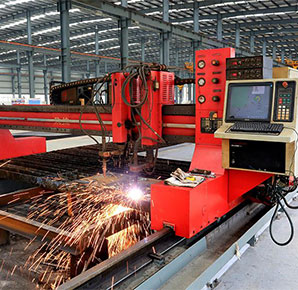 Flame cutting, also called oxyfuel cutting, is a common machining method for heavy plate.
Flame Cutting
-
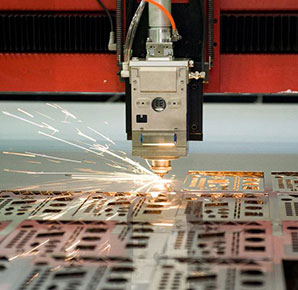 Plasma cutting is a process that cuts through electrically conductive materials by means of an accelerated jet of hot plasma.
Plasma Cutting
-
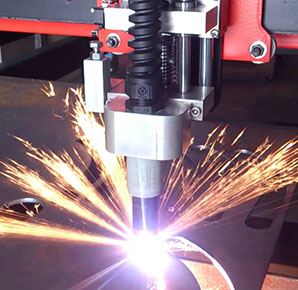 Basically when cutting with the laser, the beam is focused on the material through the hole in the nozzle.
Laser Cutting
-
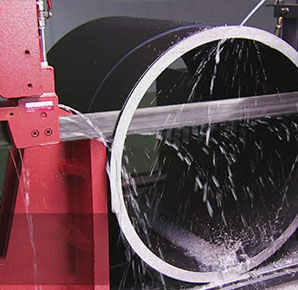 According to the form of the tool, sawing/ saw cutting is divided into bow sawing, circular sawing, band sawing and sawing of the grinding wheel.
Saw Cutting
Latest Products
-
 Special Shaped Steel Cutting is for Construction.
Special Shaped Steel Cutting for Construction
-
 Machining involved: cutting, grinding
Metal Steel Cutting for Construction Machinery
-
 Application: ships building, construction. Katalor can provide a wide range of laser cutting, plasma cutting, flame cutting or...
Mild Steel Angle Cutting Parts
-
 Machining involved: saw cutting, grinding, surface treatment
Saw Cutting for Alloy Steel Bars
-
 Machining involved: cutting, bending, drilling, surface treatment
Cutting Alloy Steel Equal Angles
-
 Shape: customized. Custom is our specialty, materials and finish coating can be various.
Metal Steel Plate Customized Machining
-
 Material: carbon steel. Machining involved: saw cutting; Whole inspection procedures (IQC, PQC and FQC) and QA plan are carri...
Square Pipes Cutting
-
 Customized Heavy Plates Cutting Parts are for Engineering Machinery. Material: carbon steel Machining involved: flame cutting...
Customized Heavy Plates Cutting Parts
CONTACT US
No limited to time and space, you can call for our online-service personnel for consultation, or fill in the table below for an enquiry. Your message will be promptly resolved.
- Tel:+86-21-61182423
- Fax:+86-21-61182425
- E-mail:[email protected]
- Skype:shanghai.katalor
- Address:Unit 6,lane 2500,xiupu Road,Kangqiao Industrial Area,Pudong New District,Shanghai
- Online Consultation
- After-sales Engineer