


H-beam laser cutting: high efficiency and precision
2026-07-03
In modern metal processing, H-beams, named for their cross-sectional shape resembling the letter "H," possess excellent mechanical properties and structural stability, making them widely used in building frames, industrial plants, bridge supports, and the skeleton structures of various heavy machinery. Traditional H-beam processing methods, such as flame cutting or plasma cutting, while widely applied, have limitations in precision, efficiency, and cut quality. With the maturity and widespread adoption of laser technology, laser cutting of H-beams is gradually becoming a key process for improving the quality of metal processing.
The basic principle of laser cutting is to use a focused, high-power-density laser beam to irradiate the workpiece, causing the material at the irradiated area to rapidly reach its melting, vaporization, or ignition point. Simultaneously, a high-speed airflow coaxial with the beam blows away the molten material, thus achieving a thermal cutting method that cuts the workpiece. When this technology is applied to H-beams, its advantages are fully demonstrated.
Technical Advantages: Why Choose Laser Cutting for H-beams?
1. High Precision and Complex Pattern Processing Capability
The core advantage of laser cutting lies in its extremely high positioning accuracy and repeatability. Through precise control by a computer numerical control system, the laser beam can move strictly according to a preset two-dimensional or three-dimensional drawing path. For profiles like H-beams that require complex holes, curved contours, or fine grooves to be cut into their webs or flanges, laser cutting can easily achieve high-precision patterns that are difficult to achieve using traditional methods. Whether it's bolt holes, pipe through-holes, or irregularly shaped ends, it can obtain precisely sized, smooth-edged cuts, providing an excellent fit for subsequent assembly and welding, effectively reducing secondary processing and assembly errors.
2. Satisfactory Cutting Surface Quality
Laser cutting is a non-contact processing method. No mechanical stress is applied to the workpiece during the cutting process, avoiding material deformation. The resulting cut surface is typically smooth and flat, with good perpendicularity, and little or no slag, which is easily removed. The heat-affected zone of the cut is narrow, minimizing the impact on the mechanical properties of the H-beam base material. A high-quality cut surface not only has a clean appearance, but more importantly, in many load-bearing or critical connection areas, good surface quality means a more uniform stress distribution and higher connection reliability.
The basic principle of laser cutting is to use a focused, high-power-density laser beam to irradiate the workpiece, causing the material at the irradiated area to rapidly reach its melting, vaporization, or ignition point. Simultaneously, a high-speed airflow coaxial with the beam blows away the molten material, thus achieving a thermal cutting method that cuts the workpiece. When this technology is applied to H-beams, its advantages are fully demonstrated.
Technical Advantages: Why Choose Laser Cutting for H-beams?
1. High Precision and Complex Pattern Processing Capability
The core advantage of laser cutting lies in its extremely high positioning accuracy and repeatability. Through precise control by a computer numerical control system, the laser beam can move strictly according to a preset two-dimensional or three-dimensional drawing path. For profiles like H-beams that require complex holes, curved contours, or fine grooves to be cut into their webs or flanges, laser cutting can easily achieve high-precision patterns that are difficult to achieve using traditional methods. Whether it's bolt holes, pipe through-holes, or irregularly shaped ends, it can obtain precisely sized, smooth-edged cuts, providing an excellent fit for subsequent assembly and welding, effectively reducing secondary processing and assembly errors.
2. Satisfactory Cutting Surface Quality
Laser cutting is a non-contact processing method. No mechanical stress is applied to the workpiece during the cutting process, avoiding material deformation. The resulting cut surface is typically smooth and flat, with good perpendicularity, and little or no slag, which is easily removed. The heat-affected zone of the cut is narrow, minimizing the impact on the mechanical properties of the H-beam base material. A high-quality cut surface not only has a clean appearance, but more importantly, in many load-bearing or critical connection areas, good surface quality means a more uniform stress distribution and higher connection reliability.
CUTTING METHOD

-
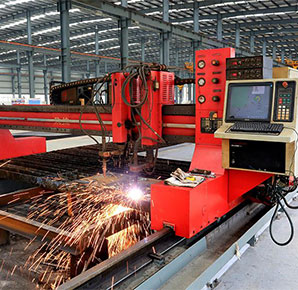 Flame cutting, also called oxyfuel cutting, is a common machining method for heavy plate.
Flame Cutting
-
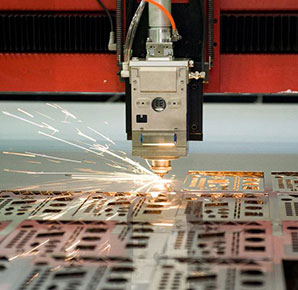 Plasma cutting is a process that cuts through electrically conductive materials by means of an accelerated jet of hot plasma.
Plasma Cutting
-
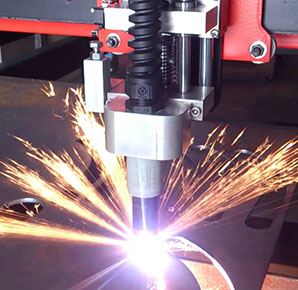 Basically when cutting with the laser, the beam is focused on the material through the hole in the nozzle.
Laser Cutting
-
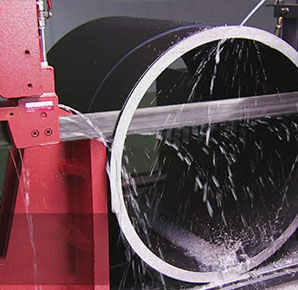 According to the form of the tool, sawing/ saw cutting is divided into bow sawing, circular sawing, band sawing and sawing of the grinding wheel.
Saw Cutting
Latest Products
-
 Material: carbon steel. Machining involved: saw cutting; Whole inspection procedures (IQC, PQC and FQC) and QA plan are carri...
Square Pipes Cutting
-
 Machining involved: cutting, bending, drilling, surface treatment
Cutting Alloy Steel Equal Angles
-
 Material: stainless steel Machining involved: plasma cutting, grinding, polishing
Plasma Cutting Stainless Steel Plate
-
 Material: stainless steel Machining involved: flame cutting, polishing
Stainless Steel Seamless Tubes Cutting
-
 Our products cover the fields of construction machinery, power systems, material handling and transportation machinery, metall...
Carbon Steel Pipes
-
 Material: stainless steel. Laser cutting: high precision, fastest cutting method, suitable for cutting iron steel within 20mm....
Automobile Steel Parts
-
 Katalor can provide a wide range of laser cutting, plasma cutting, flame cutting or steel machining parts fabrication. Flame ...
Heavy Plates Flame Cutting
-
 Machining involved: saw cutting, grinding, surface treatment Application: construction structure
Profile Steel Cutting
CONTACT US
No limited to time and space, you can call for our online-service personnel for consultation, or fill in the table below for an enquiry. Your message will be promptly resolved.
- Tel:+86-21-61182423
- Fax:+86-21-61182425
- E-mail:[email protected]
- Skype:shanghai.katalor
- Address:Unit 6,lane 2500,xiupu Road,Kangqiao Industrial Area,Pudong New District,Shanghai
- Online Consultation
- After-sales Engineer